
$21.98
Add to Cart
American Bittersweet, Celastrus scandens, Vine Seeds (Fast, Hardy, Showy)
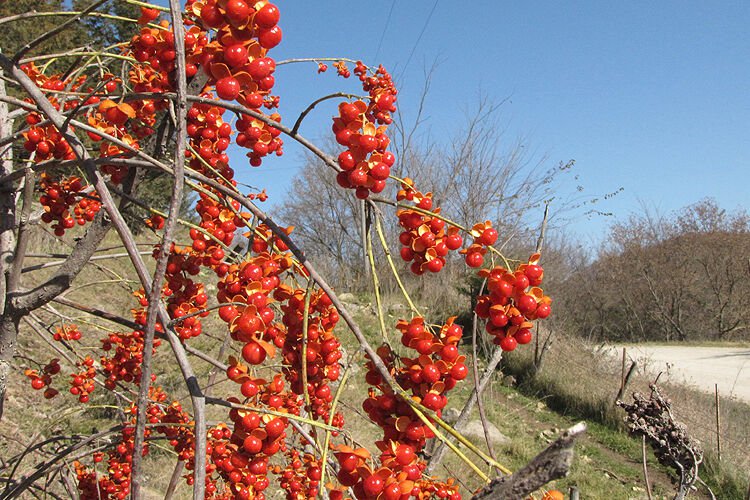


American Bittersweet Vine, Celastrus scandens, Seeds Fast Growth, Hardy, Adaptable, Easy to Grow, Climbing Vine, Showy Ornamental Fruit, Attracts Birds, Wildlife Food/Shelter, Winter Interest, Cold Tolerant American Bittersweet is a fast growing deciduous twining woody vine that is best known for its showy red berries that brighten up fall and winter landscapes. This species is native to central and eastern North America. It is often seen growing along the ground, over and through low shrubs or circling trees in the wild. American Bittersweet orange-yellow fruits are produced in July - October and are 1/4 inch round fruits in hanging clusters 2 to 4 inches long eventually splitting open to reveal bright red fleshy seeds (arils) for a showy Autumn. The branches with colorful berries and arils are used in dry flower arrangements and winter decoration. American Bittersweet is easily trained to climb walls, trellises and fences. When added to existing shrub plantings, this twining vine produces excellent wildlife cover and aids in erosion control as well. The berry-like fruits of American Bittersweet are showy and provide winter food for wildlife species such as grouse, pheasant, quail, rabbit and squirrel. In the 1700s, plants were given the name Bittersweet by European colonists because their fruits purportedly resembled in appearance the fruits of a Eurasian nightshade (Solanum dulcamara) that was known to them as Bittersweet. The common name of False Bittersweet also came to be used for the within species to distinguish it from the Eruasian nightshade. American Bittersweet is the generally accepted common name that is used today, in large part to distinguish this American native from its aggressive Asiatic relative, C. orbiculatus (Oriental Bittersweet) which has escaped cultivation and is naturalizing in parts of eastern and central North America. All parts of Bittersweet are reported to be poisonous but songbirds, ruffed grouse, pheasant, and fox squirrel eat the fruits. The Menominee, Ojibwa, and Potawatami tribes of North American Indians have used the inner bark as an emergency food. Leaf: Alternate, simple, elliptical to ovate, pointed tip, 2 to 5 inches long, finely serrated, somewhat rounded teeth. Flower: Inconspicuous, pale yellowish-green, in terminal clusters, appearing in late spring. Fruit: Very attractive, orange-yellow fruit capsules in clusters which when opened expose a bright red seed surrounded by orange scales, 1/3 inch across; ripen in the fall and are visible throughout the winter. Twig: Twiny, light brown, with small pointy buds at nearly right angles to the stems. No tendrils or aerial roots present. Bark: Brown, initially smooth, later corky with diamond-shaped patterns, much later becomes finely scaly. Form: Climbing vine, with an open, spiraling pattern. Forms dense thickets along fences. Some stems may become several inches in diameter. Other Names: Climbing Bittersweet, False Bittersweet, Climbing Orange-root, Fever-twig, Fever-twitch, Staff-vine, Jacob’s-ladder Zone: 3 to 8 Growth Rate: Medium - Fast Plant Type: Deciduous Vine Family: Celastraceae Native Range: North America Height: 15 to 20 feet Spread: 3 to 6 feet Shape: Tendril-twining, semi-woody ornamental vine Bloom Time: May-June Bloom Color: Greenish-white to yellow Fall Color: Yellow Sun: Full Sun to Part Shade Water: Medium Maintenance: Low Site Requirements /Soil Tolerances: Easily grown in most soils. Best in lean to average soils with regular moisture in full sun. Lean soils help restrain growth. Will grow in part shade, but needs full sun for best flowering and subsequent fruit display. Culture: Prune in late winter to early spring. Mature vines require little pruning other than removal of dead or excess growth. These plants are primarily dioecious (separate male and female plants), although some have a few perfect flowers. Female plants need a male pollinator to produce the attractive fruit that is the signature of this vine. Uses: Woodland gardens, naturalized areas. Provides quick cover for fences, arbors, trellises, posts, walls or other structures in the landscape. Also may be grown along the ground to camouflage rock piles or old tree stumps. Sowing Celastrus scandens Seeds: For best results, please follow the instructions in the order provided. Scarify: Soak in water 24 Hours Stratify: Cold 90-120 days, 40 Degrees F in a Moist Medium (Not wet). Germination: Sow 1/8” Deep, Keep Moist (Not wet).


 ID, Jawa Tengah